NOTES FROM THE OPERATION
How I Improved Warehouse Picking Efficiency Through Batch Picking and Zone-Based Operations
Practical lessons in batch picking, zone picking, ABC slotting and sort-to-pack, with WMS checks and a clear approach to measuring warehouse efficiency.
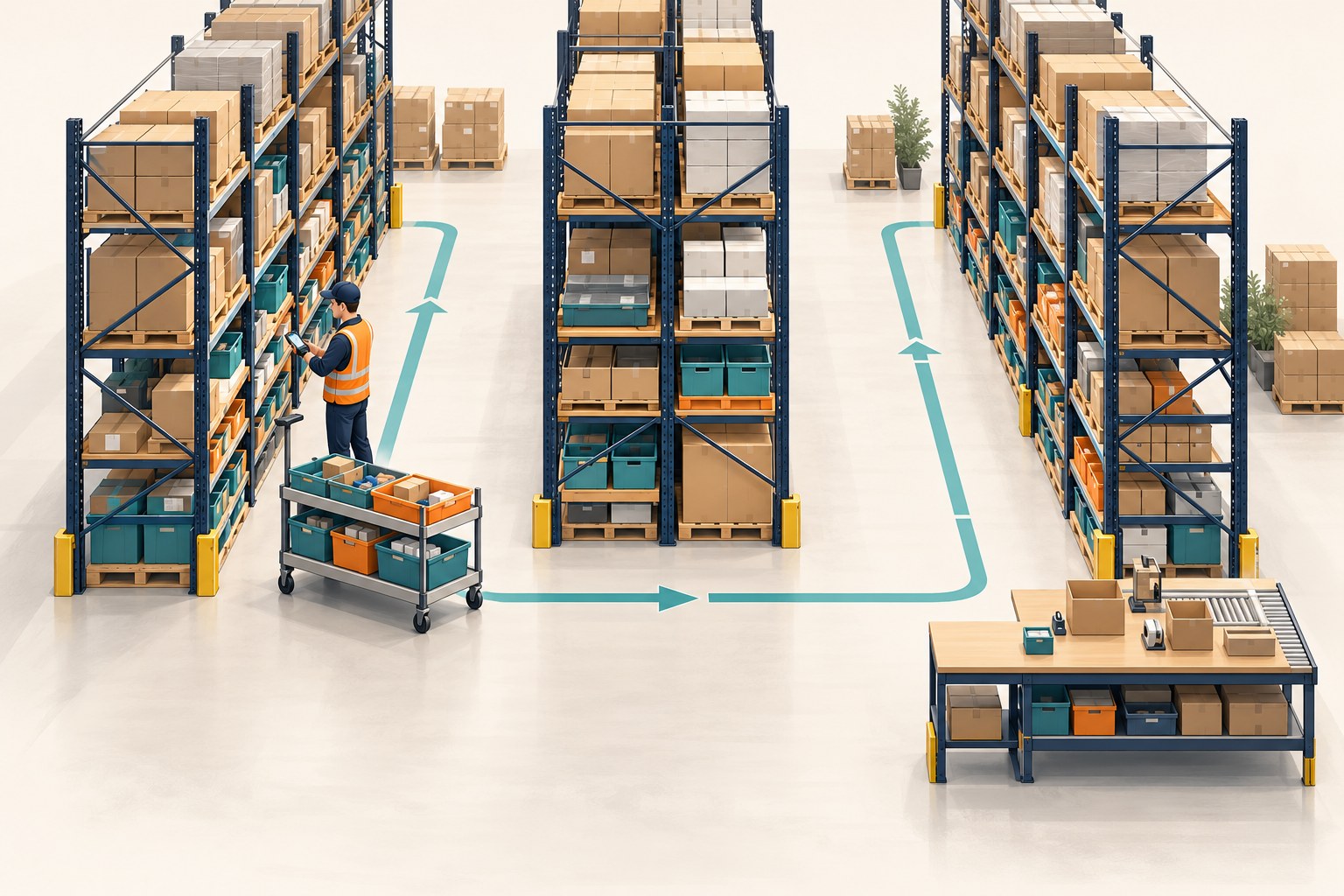
Single order picking is easy to understand: complete one order, return to the packing area and start the next. The difficulty appears when many orders need products from the same shelves. Staff repeat the same journeys while the packing bench waits for work.
In my warehouse operations experience, improving that flow meant looking at product locations, picking routes and the handover to packing together. Batch picking and zone-based operations helped me organise the work around the order profile rather than treating every order as a separate trip.
This article explains that practical approach. It does not claim a measured percentage improvement: the worked example below is illustrative, and a reliable before-and-after comparison needs comparable operational records.
Where single order picking creates avoidable work
The first question I ask is where the time goes. A picker can be busy throughout a shift while spending much of it walking, searching or waiting for a location to be replenished.
- Repeated journeys to popular SKUs add travel without adding completed orders.
- Similar-looking variants increase checking time and the risk of a wrong pick.
- Empty pick faces interrupt otherwise sensible routes.
- Large batches arriving together can move the queue from picking to packing.
Single order picking still has a place for urgent, unusual or bulky orders. The objective is to select a method that suits the work, with an exception route for orders that should not join a normal batch.
Using ABC analysis to organise pick locations
ABC analysis gives a useful starting point for slotting. For picking efficiency, I focus on pick frequency and movement, alongside size, weight and handling requirements. A classification based only on stock value answers a different question and may leave frequently picked low-value items in inconvenient locations.
A items are the most frequently accessed products, B items move less often and C items are slower movers. The boundaries should follow the actual order data rather than a rigid assumption that every business has the same split.
Fast movers need accessible pick faces and a reliable replenishment routine. Heavy items need suitable handling positions. Similar variants need clear separation and identification even when they belong to the same product family. Moving popular products closer together is useful only if it does not create congestion or unsafe handling.
I also review which SKUs appear together. A short route for a common product combination can be more useful than an attractive shelf layout that ignores real baskets.
Batch picking: collect shared demand in one route
Batch picking groups several orders into a combined picking task. The picker collects the required quantities on a planned route, and the products are then allocated to the correct orders. Order identity must remain traceable throughout.
For example, imagine six orders each containing one identical cable. Six separate trips would revisit the cable location six times. A combined task could collect six cables during one visit, followed by controlled allocation to the six orders. This is a simplified illustration of location visits, not a claim that total fulfilment time falls by the same proportion.
Batch size needs to fit the trolley, available space, product characteristics and packing capacity. Increasing it without those checks can create mixed stock, awkward handling and a sorting queue. Where each order has its own tote during picking, that is often described as cluster picking; it should not be confused with collecting mixed units for later sorting.
Zone picking: give each area a clear responsibility
Zone picking assigns picking work to defined warehouse areas. An order spanning several zones needs a controlled handover or consolidation step so that every line reaches the same completed order.
I consider the workload in each zone as well as the walking distance. Equal floor space does not mean equal effort: one small area holding fast movers may generate more picks than several larger areas combined.
Clear location codes, scan checks and a visible owner for incomplete orders are essential. Staff also need enough cross-training to cover another zone when demand changes or a colleague is absent. A zone should organise responsibility without becoming a barrier to helping the rest of the operation.
Batch and zone picking can work together, but the combination needs to earn its complexity. For a small team or a changing order mix, a simpler process may be easier to control.
Using WMS records and a time and motion study
A warehouse management system, or WMS, helps connect orders, locations, quantities and task status. I use that information alongside direct observation: a system timestamp alone may hide searching, replenishment delays or a queue at the packing bench.
A useful time and motion study separates travel, locating stock, scanning, handling, waiting, sorting and packing. The comparison should use a similar order mix, staffing level and measurement window. Lines per order and bulky items matter; comparing a quiet day of simple orders with a complex peak day would be misleading.
The measures I would review together are:
- Correctly picked lines per productive picking hour, with the time definition recorded.
- Travel and waiting time per comparable batch.
- Pick errors and short picks, including errors discovered at packing.
- Time from order release to readiness for dispatch.
- Packing backlog and on-time dispatch, so local gains do not hide a downstream delay.
Sort-to-pack: make the handover do useful work
Sort-to-pack means allocating batch-picked products to their customer orders at the packing stage. With an organised bench, order identification and scan verification, sorting can feed directly into packing rather than creating another pile for someone else to handle.
The useful question is how many times an item is touched before it is ready to leave. A shorter picking route is less valuable if the products then wait in an unlabelled container or need to be counted repeatedly.
I would pilot the arrangement on a manageable order group, observe the whole journey and adjust the batch size or bench layout before expanding it. Missing items should move into an identified exception process rather than holding up every complete order.
What I take into the next warehouse improvement
My starting point is the movement of work: where products sit, how staff reach them and how each order becomes ready for dispatch. Batch picking, zones and WMS tools are useful when they reduce unnecessary movement while preserving accurate order allocation.
For the connected controls, read my articles on practical inventory control and stock discrepancies and managing 400 daily orders.
For terminology and alternative picking arrangements, see Oracle NetSuite's batch picking guide and zone picking guide.
Cover: AI-generated editorial illustration of a warehouse picking workflow; it does not show my actual workplace.